
Douglas County Resident Lookup Coverage
Douglas County records answer different questions about the same person. The Douglas County Assessor property search links a named owner to a parcel and a situs address. It also gives a separate mailing address. It does not list occupants. Each voter result, court docket, certificate, archive entry, license, and permit sits with its own custodian. Each has its own time span. Start narrow. Pick the one source that can answer your question. Then compare a second record before treating a name match as settled.
| Record set | What it can confirm | Where or coverage | Access |
|---|---|---|---|
| Assessor property roll | Owner, parcel situs, mailing address, legal description | Current Douglas County property search; older books in State Archives | Free portal; custom report $50 per hour |
| Treasurer tax account | Taxpayer, account, situs, payment or delinquency context | Current and previous-year account search | Free search; payment fees only when paying |
| Recorded instruments | Grantor, grantee, conveyance, legal description, recorded details | Landmark Web index reaching to 1866; images vary | Free index or image where available; copies may cost |
| Voter registration | Current registration confirmation and permitted public fields | State lookup and Douglas County list products | Free lookup; requested files and protected fields differ |
| Court dockets and files | Case, party role, class, dates, disposition, probate links | Colorado Judicial Branch, Combined Courts, and separate municipal courts | Limited search free; copies and name searches have fees |
| Vital records | Eligible birth, death, marriage, or divorce event | Local and state custodians; no public name index | Application, ID, eligibility proof, and fee |
| Probate | Decedent, heirs, representative, estate address or property | Current court files; State Archives cases 1865-1945 and wills 1897-1961 | Request and copy rules apply |
| DCL historical files | Older address, phone, school, relative, death, or community clue | Archives, yearbooks, school censuses, newspapers, oral histories | Reading Room, appointment, staff retrieval, or digital browse |
| SOS business filings | Entity, status, agent, principal office, filing history | Colorado business database | Free summary; products or certified records may cost |
| DORA license lookup | Credential name, type, number, status, discipline or facility link | Colorado public license search | Free public lookup |
| CBI registry | Narrow statutory registry result | Colorado public registry, updated hourly | Free search; some request products cost |
| Great Colorado Payback | Possible unclaimed-property owner or former-name clue | State Treasury name and business search | Free search; a claim needs proof |
| Permits and local records | Address project, applicant, contractor, owner, agent, date, or status | County archive from 1978; city portals vary | Public portal or narrow records request |
Ownership questions start with the Assessor and Treasurer. Legal events go elsewhere. Use the court, vital, or probate custodian for those. For a historical person, DCL and the State Archives may beat a current portal. Business, license, registry, and permit results show a role or record event, not a complete biography.
Normalize a Douglas County Resident Lookup
Same-name errors come easily in Douglas County. The county spans Castle Rock, Parker, Castle Pines, Lone Tree, and Highlands Ranch. It also covers rural communities and older place names. Test more than one spelling. Try a full name, middle initial, suffix, former or married name, and spelling variant. Also try a trust or organization form. Then match the town or postal label used when the record was created. A Littleton mailing label can point to unincorporated Highlands Ranch. A historical entry may use Frankstown, Russellville, Sedalia, or another community name.
Geography narrows a name. It cannot turn one database into another, but it cuts the field. Compare a parcel or account number, owner mailing ZIP, court county and courthouse, or business ID. Then add license number, school year, or recorded reception number. Keep the source date beside every result. Dates matter. A 2026 parcel owner answers one question. A past deed, a school record, and a current registration answer different questions.
Same-name check. Treat a relationship, address, or business role as a hypothesis until a second dated record and the responsible custodian support it.
Douglas County Resident Lookup Court Fields
The Colorado Judicial Branch runs a limited statewide docket search covering Douglas County cases. It demands a filter beyond a date. Select a judicial district, county, courthouse, or division first. Then add party or attorney details. Municipal courts in Castle Rock, Parker, Lone Tree, and Castle Pines are separate custodians, so a Combined Courts search never replaces a city request.
| Group | Field | Type | Use |
|---|---|---|---|
| Location | District, county, courthouse, division | Dropdown and text | Limit a same-name search to the right court geography. |
| Date | Date range or specified date | Dropdown and text | Set a time window instead of searching every year. |
| Case number | Four-digit year, class, sequence | Text and dropdown | Use a known case number to move beyond a name lead. |
| Party | Individual or business, first name, last name, business name | Radio and text | Keep an individual party separate from an entity. |
| Attorney | Attorney name or bar number | Radio and text | Use only when the public result exposes counsel information. |
A docket result can carry the case number, court, county, courthouse, division, case class, filed or open date, caption, party name and role, attorney and bar number, docket event, hearing details, judgment or disposition, status, document link, and a sealed or suppressed indicator. Docket fields stack up quickly. A name-only hit is not identity proof.
When a summary falls short, the official court record and document request form is the next channel. The form is simple enough. It asks for requestor contact details, case number, and document category. A certified or exemplified choice is offered when needed.
Court fees start at $0.25 per copy page, with a name search at $5. Certified or exemplified copies cost $20. A transcript of judgment is $25. Research or redaction past the first hour runs $30 per hour. Off-site retrieval is charged at actual cost. The response target is 3 business days unless circumstances extend it. A government photo ID may be required for restricted material.
Check the Colorado Judicial docket search screen before running a name. The field order is worth learning first.
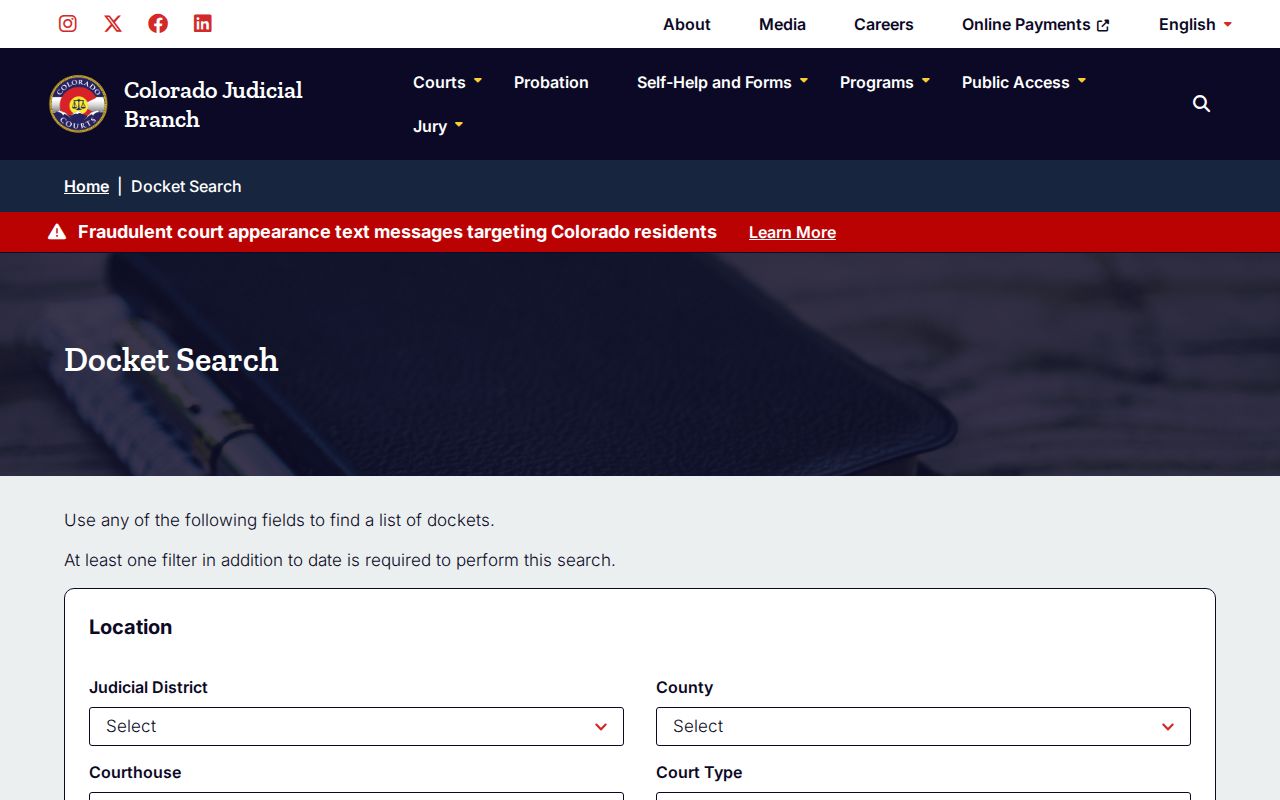
The docket screen rewards patience. Combine county, date, case, party, and attorney filters before treating any result as a true Douglas County match.
Verify One Douglas County Resident
Use a short verification chain. Collecting every record on offer does more harm than good, because the goal is to resolve identity and source limits, not to turn a name into an unqualified address claim.
- Normalize the name with middle initials, former names, suffixes, spelling variants, and organization or trust forms.
- Anchor the name to geography through a parcel, situs or mailing city, voter ZIP if lawfully available, court county, business office, or school year.
- Add a second identifier such as birth year, account, parcel, case, reception, business, license, or school-year number.
- Check time. Separate a current registration, a 2026 parcel, a 2019 deed, a 2008 directory entry, and a 1950 census household.
- Treat spouses, heirs, co-entries, agents, and relatives as record relationships, then ask the custodian to resolve a contradiction.
Three terms keep the result honest:
- Docket
- A court’s public case and event index. It is not the full case file.
- Index versus image
- An index supplies searchable summary fields; an image is the recorded page or filed document and may require a request or fee.
- Certified copy
- A custodian-attested copy issued for an eligible purpose. It is different from a screen view or an uncertified photocopy.
Split your notes by record type. For property, keep situs and mailing addresses separate. For court and vital records, keep the case or certificate rule beside the name, and for archive work write the collection, call number, year, and page rather than a modern address guess.
Douglas County Vital Record Verification
Colorado birth and death certificates come through the Douglas County Health Department or the CDPHE State Registrar. Marriage and civil-union copies go elsewhere. The Clerk and Recorder holds those. Divorce, separation, and annulment files belong to the district court. C.R.S. 25-2-117 keeps vital statistics confidential. No public searchable name index exists. An old date alone does not open a certificate.
The Colorado vital-record order route shows the state application, ID, eligibility, and mail, online, or appointment channels.
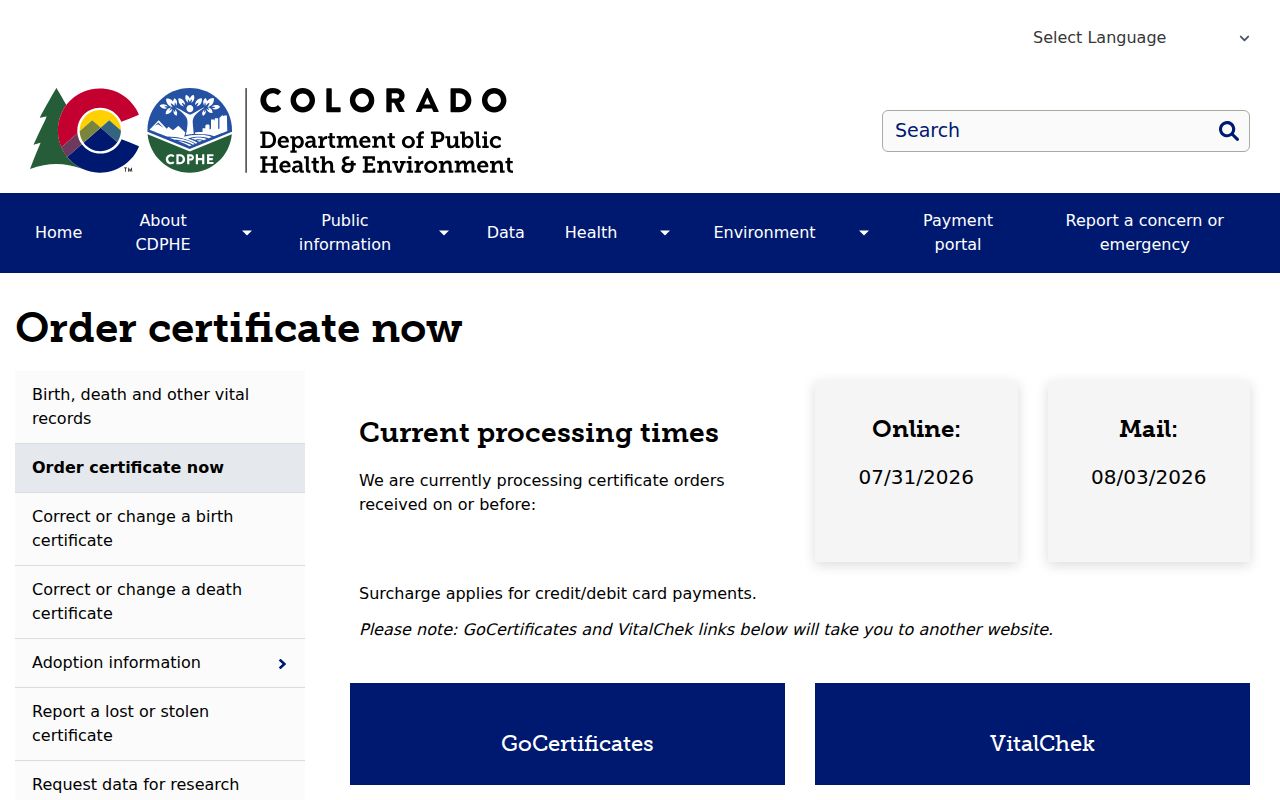
Use the state route when a local search does not hold the event or when a statewide handoff is required. Eligibility still controls the copy.
The Douglas County Health Department vital-records page lists the local birth and death application path along with the direct and tangible interest rule. A first copy costs $25. Additional copies on the same county order are $20. The application records the requestor, relationship, registrant or decedent, dates and places, parent or spouse details as applicable, ID, quantity, payment, and attestation. False-pretenses access is subject to C.R.S. 25-2-118.
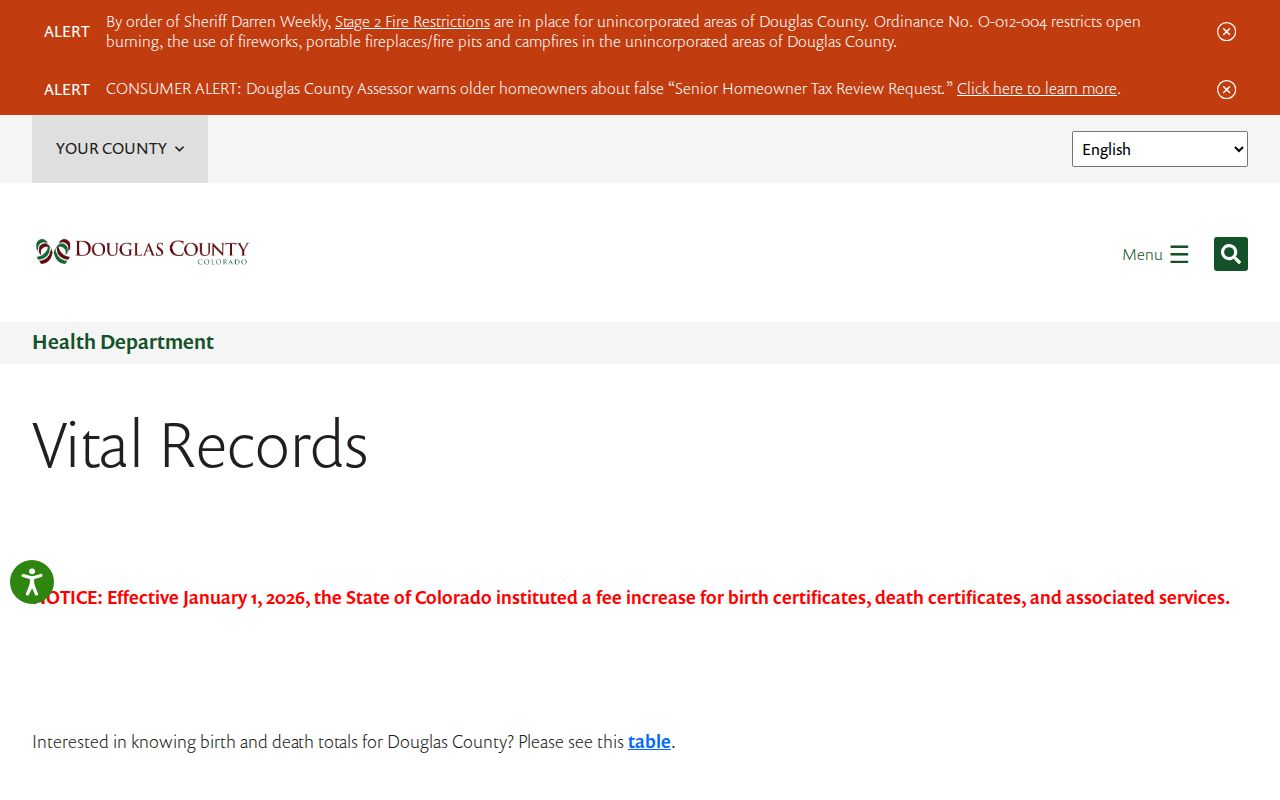
For an eligible requester in Douglas County, the local vital records office handles verification directly. Marriage and court files sit elsewhere, though, and each must be requested from its own custodian.
Douglas County Voter Lookup Checks
Colorado's Online Voter Registration Lookup is the entry point. It wants a first name, last name, ZIP, and birthday. It also tells you to type the name exactly as registered. After a move, try the old home ZIP too. Confidential voters and protected preregistered minors may simply not appear. So an empty result is not proof of absence. Douglas County rounds this out with its own voter products. The standard list refreshes every business day. History files open after certification, and ballot and rejected-cure files follow their own election-cycle cadence. The Colorado voter lookup confirms one registration. It is not an unrestricted street roster of Douglas County residents.
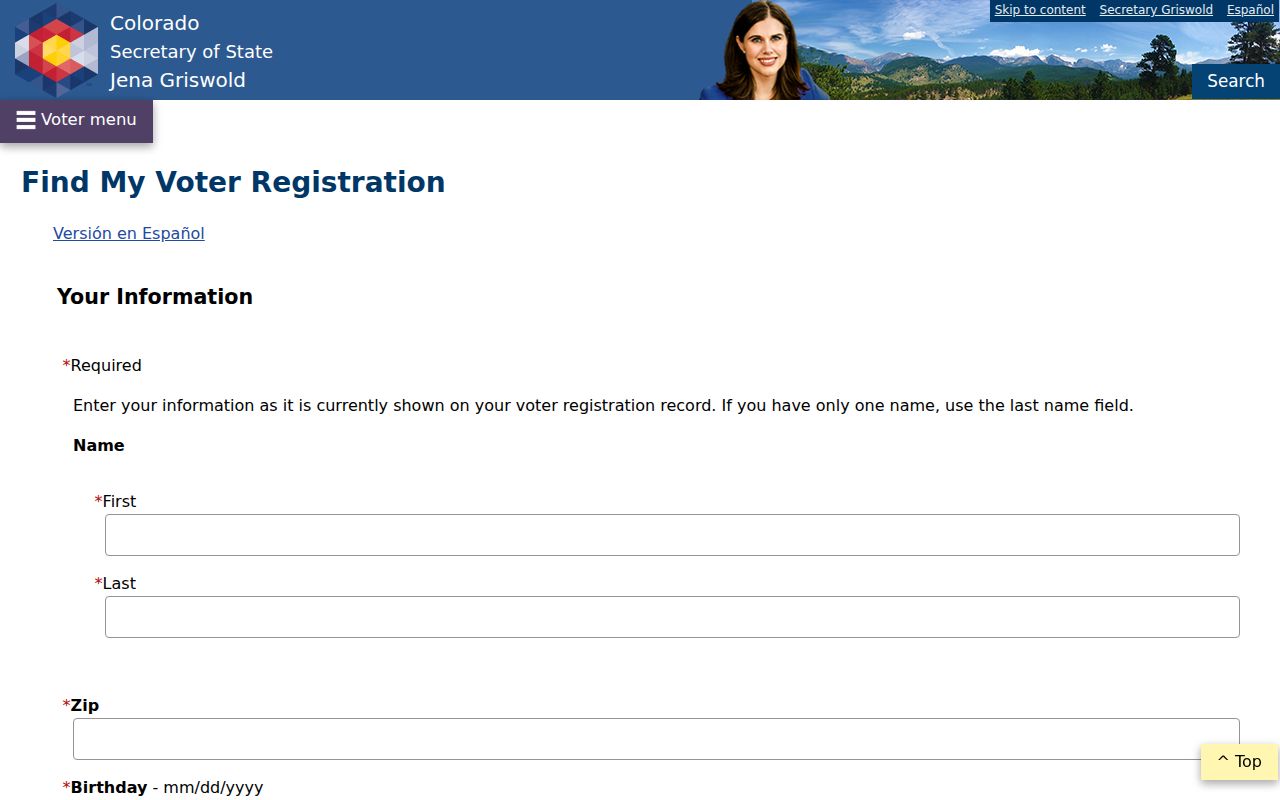
What the public voter files leave out matters just as much. Confidential voters and protected minors are excluded. So are SSNs, ID numbers, electronic signatures, email, full birth dates, and how anyone voted. The statewide data-request form is where bulk products come from. It takes report choices, date ranges, delivery details, copies, and payment. The listed fee is $50 per report. A 2025-26 cycle subscription costs $1,000. Douglas Elections sits at 125 Stephanie Place, Castle Rock. Reach the office at 303-660-7444, Monday through Friday from 8 a.m. to 5 p.m.
Behind the scenes, the county runs a daily Address Matching Practice. It compares voter address components against Assessor data. This gives tax authorities and districts consistent geographies. That work can explain why an address looks normalized in a file. But it never converts the owner roll into a voter list or exposes protected fields.
Business Clues in a Resident Lookup
Business records can anchor a Douglas County resident lookup in surprising ways. The Colorado Secretary of State Business Database searches names, trademarks, trade names, entity IDs, and document numbers. A summary may show entity name, status, formation date, form, jurisdiction, principal office, mailing address, registered agent, filing history, and document links. One caution applies. A registered agent fills a service role. That role proves nothing about ownership or residence. So keep the entity ID and filing date beside any personal name.
DORA's public license lookup narrows a credential by profession, name parts, license type, number, status, or wildcard. A facility or discipline result is an affiliation clue rather than a full personal record. County and city permit portals add applicant, contractor, owner, agent, project, and status fields. More than 1.2 million archived county permits reach back to 1978. City portals and retention schedules vary. Great Colorado Payback can be searched by name, business, former name, or ZIP. A claim still needs proof.
Heirs, Classmates, and Birth Parents
Every person search starts with one question. Who is this person to you? An heir, a classmate, and a birth parent each belong to a different custodian with a different stopping point. Treat any single "no result" as a pause, not a verdict, because the next system may hold the answer a Douglas County name search needs.
- Heir: begin with the probate docket, request eligible will or estate material, then compare obituary, cemetery, and deed records.
- Former classmate: start with DCL yearbooks, school censuses, oral histories, and school notices before using a later record.
- Birth parent or adoption connection: use CDPHE adoption information, the Colorado Voluntary Adoption Registry, original-certificate eligibility, or the confidential-intermediary route.
- Business owner or agent: compare SOS filings, DORA credentials, permits, and recorded documents, keeping the business role separate from residence.
- Deceased resident: use obituary or clipping files, an eligible death-record request, probate, cemetery material, and an estate deed.
For phone books, school material, and local directory questions, the Douglas County city directory page maps the historical shelf route. Douglas County Libraries and State Archives holdings are time-specific evidence. They document a moment, not a current member list.
The Same-Name Douglas County Trap
A name alone is a weak thread in Douglas County. An owner, a voter, a directory subscriber, a court party, a business agent, and an occupant. These are not interchangeable observations. The county's blend of planned communities, old town centers, rural stretches, and loose postal labels lets a name look local. It may belong to someone else or another era. Keep legal municipality, postal city, subdivision, ZIP, and county as separate fields. Check the parcel, case, school year, or filing date before joining anything.
A narrow official register invites its own confusion. The Colorado Bureau of Investigation registry updates hourly. Yet it is not comprehensive. It never exposes every person, victim detail, or historical event. Use it only for the statutory result it provides. Then verify identity with a second lawful source. The Colorado registry information page spells out the public search and request limits.
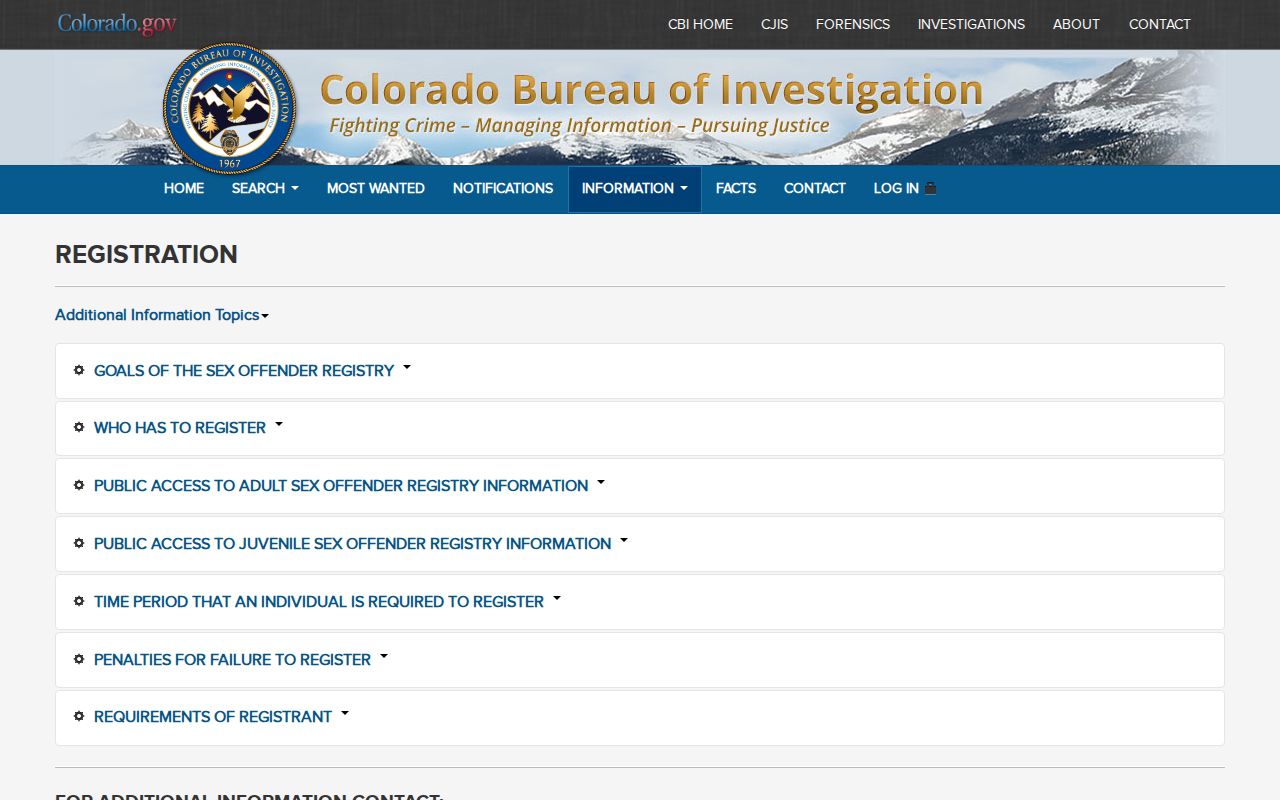
Registry scope teaches a lesson for every Douglas County resident search. Read each result within the rule and record type that produced it, nothing more.
Douglas County Resident Lookup Boundaries
Official records rarely list every person at a parcel. Non-owner occupants, household members, utility customers, DMV addresses, protected voters, confidential vital records, sealed cases, juvenile files, and adoption originals can all sit outside an ordinary name search. Municipal court records stay with the city custodian, too. So a missing result has many possible meanings: the wrong county, an old name, a protected record, incomplete digitization, or simply the wrong record type.
Some gaps are deliberate. The Colorado Address Confidentiality Program gives eligible participants a substitute address with mail forwarding while the real address stays protected, and ACP is separate from confidential-voter status. HB25-1195 adds a no-fee address-confidentiality route for first responders or their spouses, effective January 1, 2026. Layered on C.R.S. 24-30-2101 et seq., 1 CCR 103-6, and other sealing rules, these protections mean one thing clearly. Sometimes no result is the correct outcome.
Lawful personal use. Use records for a specific, lawful purpose. Do not use a Douglas County resident lookup to stalk, harass, intimidate, or harm anyone, and do not try to defeat a confidentiality program.
CORA for a Stopped Resident Lookup
A portal that stops at a summary does not end the trail. A narrow CORA request to the right custodian usually beats a demand for everything. The Douglas County Colorado Open Records Act route responds best to specifics. Name the department and the record type. Give a date range, an address, or a case number. State the exact field or document you want. The county aims to answer within three working days. A seven-day extension is possible, and fees may apply. City custodians keep separate records routes of their own.
Fixing a wrong entry takes a different path. Bring the record ID and documentary proof to the office that owns the data. Elections manages registration, the Assessor manages assessment fields, and the Recorder handles an indexed instrument. The court handles dockets and copies, while the vital custodian handles certificates. A CORA request can surface a retained record. It cannot erase a protected category or force disclosure.