
Douglas County City Directory Collections
Douglas County city directory holdings are scattered far and wide. Regional catalogs, local phone books, and archive shelves each hold pieces. No single complete run gathers them in one place. The publisher with the deepest catalog trail is XL Directory Service. Its New Denver Suburban Directory appears in catalogs from 1927 onward. Entries for 1957 and 1961 are included. The cataloged area reaches beyond the county seat. It covers Littleton together with Douglas County communities, which helps with county-wide research. Even so, that regional scope proves neither a Castle Rock-only edition nor a Parker-only run.
| Collection | Years | Where Held | Access |
|---|---|---|---|
| XL New Denver Suburban Directory | 1927 onward; catalog entries 1957 and 1961 | FamilySearch catalog and affiliate libraries | Catalog record; no confirmed local scan |
| DCL phone books | Exact Douglas County run not located | DCL Archives & Local History | Staff retrieval in the Reading Room |
| Reverse or criss-cross volumes | Exact title and years not located | DCL or an archive request | Ask for street and reverse sections by year |
| Yearbooks and school censuses | Exact school runs not located; school census 1879-1964 in State Archives | DCL digital and physical holdings; State Archives | Browse digitized items or request a collection |
The table's blank spots reflect what libraries actually hold, not lost copy. No Castle Rock or Parker local run is held in these collections. No dated reverse directory or printed local entry image is held there either. An archivist can confirm the publisher, edition, town, and shelf location. Ask before you cite any year. That check matters for clean citations. The FamilySearch catalog record for the XL directory is the clearest online starting point. It documents the verified regional run and its 1957 and 1961 entries.
A catalog record can point you to a regional volume. Its coverage should never be stretched into a Castle Rock-only residents directory.
Douglas County City Directory Shelves
Douglas County Libraries Archives & Local History is the practical local stop for old phone books. It also holds related name sources. The Reading Room sits at 100 S. Wilcox Street in Castle Rock. Public hours are Monday and Friday, 8 a.m. to 4 p.m. Research help runs by appointment Monday through Friday, 8 a.m. to 4 p.m., at 303-688-7730. Most material is staff retrieved. Seating is limited, and only one box or folder comes out at a time.
Bring a pencil, not a pen. Ask before photographing or copying. A microform reader is available, and microform copies or scans may carry a fee. The DCL research guide also describes interlibrary loan for Douglas County residents: a Materials Request Form arrival can take 2 to 6 weeks. A loan can run for up to 3 weeks. These channels matter when a useful volume is not in the digital browse.
The DCL visit information sets out the Reading Room rules and the appointment route.
Staff retrieval is part of the search itself. Requesting a phone book, obituary file, or map from the shelf can surface records a keyword search never exposes.
Digitized Douglas County City Directories
The DCL digital collections browse holds school yearbooks and school censuses. It also covers photographs, one-room schoolhouse material, and oral histories. Further groups include Larkspur Historical Society material and small nineteenth-century county government records. Local documents and cultural-resource surveys round it out. It also reaches into maps, family papers, newspapers, and other community history. Think of it as a browse across varied record groups. It is not a promise that every Douglas County city directory is online. Use the DCL digital collections to test a surname, school, community, or collection title. Write down the item title and date before drawing any conclusion. A hit may point to a photograph, oral history, or yearbook rather than a directory. Even so, it can yield a place clue. It can also surface a relative name that sends the search back to the shelves.
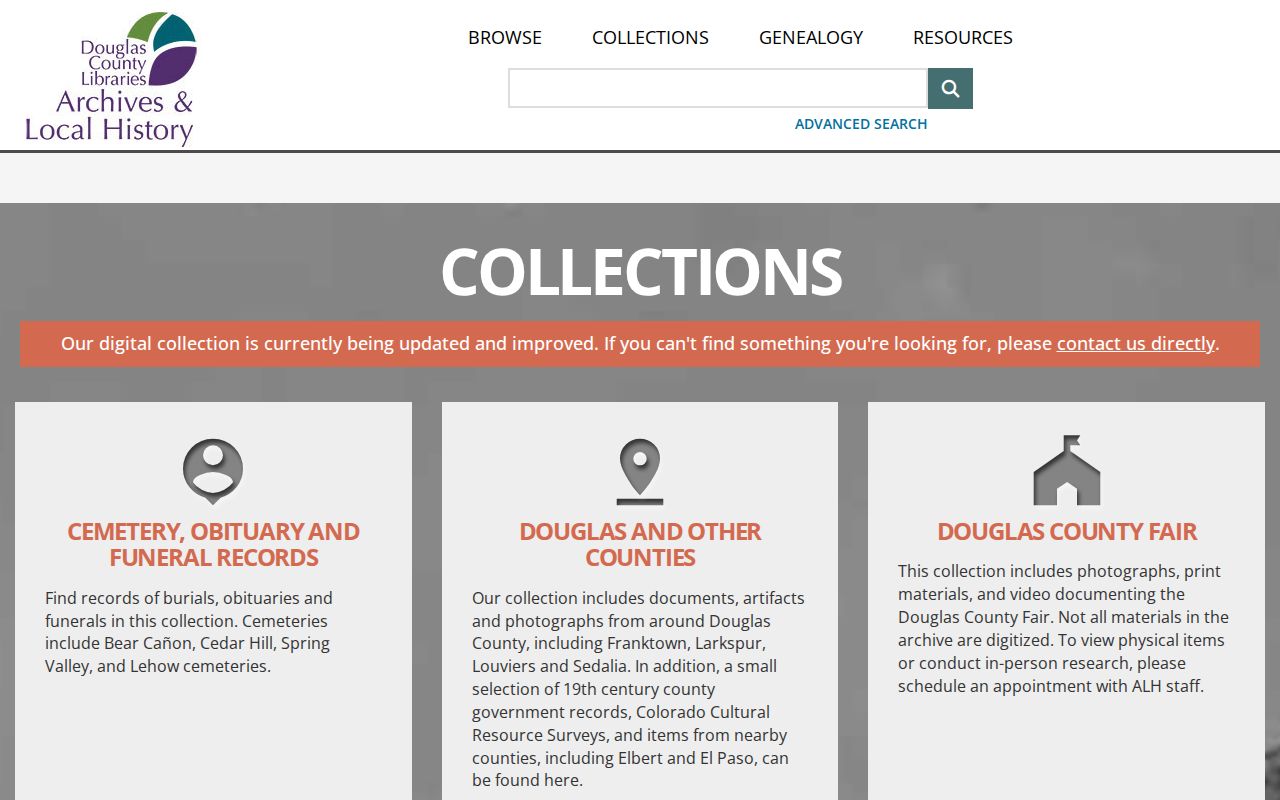
Digital browsing brings school and community context within easy reach. An archive appointment remains necessary for undigitized phone books, clippings, and manuscript material.
Douglas County City Directory Entry Anatomy
No printed Douglas County entry image is published in these collections. Treat the field list as an inspection checklist instead. Record only what the volume in hand actually shows. A regional directory may use a different layout from a local phone book. And an entry may describe a subscriber rather than every person at an address. So read carefully before assuming a full household.
| Name line | Check the full name, initials, alternate spelling, and any cross-reference actually printed. |
|---|---|
| Residence | Record the street, town or community, and unit detail only if the volume supplies them. |
| Telephone | Note the number or exchange when a telephone field is present. |
| Occupation or business | Capture it only when the entry includes a work or organization description. |
| Household mark | Look for spouse, widow, boarder, lodger, owner, or renter notation without assuming a symbol’s meaning. |
| Edition clue | Save the publisher, year, page, abbreviation key, and any new-listing or removal mark. |
Three terms help keep a reading precise:
- Criss-cross directory
- An address-first or street-order section that may point from a location to a name, when a volume contains one.
- Householder index
- An index centered on a principal occupant or household, if that is how the publisher labels it.
- Abbreviation key
- The publisher’s legend for marks and shortened words. Find it before interpreting an entry.
Note: A field-by-field inventory is reliable only after the exact local or regional edition has been inspected.
Criss-Cross Clues in Douglas County Directories
No distinct Douglas County reverse-directory title or year run appears in the confirmed holdings. Even so, DCL's verified phone-book category makes a street-order request worthwhile. Ask for a "reverse directory" or a "street directory." You might also request a telephone-book suffix. Or ask for an address index for the town and year in question. A missing name has several innocent explanations. It may mean a missing subscriber or an unlisted number. It could be a different spelling. Or it may be a volume that was never issued. Treat the address section as a clue, not a household roll. One address may name a telephone subscriber or principal occupant. Meanwhile, a deed names the owner. A street entry connects a name to a year. It cannot establish current presence or settle a same-name question alone. Cross-check against another record before you conclude.
Archive request tip. Give staff the town, street, approximate year, old postal label, and every spelling variant before asking whether a reverse section exists.
Douglas County School-Yearbook Leads
A current name search often dead-ends for an old classmate. That is when DCL yearbooks, school censuses, photographs, and one-room schoolhouse records earn their keep. The State Archives finding aid lists Douglas County school census records from 1879 through 1964. It also lists school administration records from 1865 through 1967. Those dates frame the search well. You still have to name the exact school and year when you request a pull.
Pair a yearbook name with a school census entry. An oral history, a newspaper notice, or an obituary file works too. A class photo fixes a school connection at one point in time. It cannot prove a present address. For rural records, a place name like Sedalia, Franktown, or Louviers may beat a modern postal city. That label simply did not exist when the record was made.
The Colorado State Archives finding aids document the school, court, tax, marriage, and election record runs. Those runs supplement the local shelves.
Tracing Douglas County City Directories
Treat each year as its own observation. A directory name, an 1885 Colorado census household, and a federal census household released under the 72-year rule can describe related people. Those moments can be very different ones. Boundaries moved too. The eastern portion became Elbert County in 1874. So an older locality or county label may be the right key for a later Douglas County search. What looks like a missing family is often just a shifted line on the map.
- Start with a full name, approximate year, known community, and every spelling or initial variation.
- Check the alphabetical name section, then test the street or reverse section if the volume has one.
- Write down each address, telephone exchange, household mark, publisher, page, and edition year without filling gaps from guesswork.
- Pair the directory observation with the 1885 state census or an available federal census year, keeping the two sources separate.
- Use DCL obituary, newspaper, cemetery, or probate material to test whether a disappearance reflects a move, death, or unlisted subscriber.
Need a present-day comparison for an old entry? The Douglas County resident lookup offers a separate modern-record workflow. Just do not use it to rewrite what the historical volume actually says.
Note: A directory subscriber and a census household are time-stamped clues, not interchangeable proof of residence.
Douglas County Directory Timeline
Douglas County's record history explains a directory search's many custodians. Records landed in different hands over the decades. The dates below separate documented county events and catalog entries from the still-open question of a complete local city-directory run.
| Date | Verified event | Why it matters |
|---|---|---|
| 1861 | Douglas County formed as one of the first Colorado counties. | Early locality terms may differ from current town labels. |
| 1874 | Eastern county territory became Elbert County and the seat moved to Castle Rock. | Older searches need boundary and county-name checks. |
| 1889 | A larger native-rhyolite courthouse was built. | County record history gained a physical landmark. |
| 1927 onward | XL Directory Service catalog publication begins. | A verified regional directory route, not a Castle Rock-only run. |
| 1957 and 1961 | FamilySearch catalog entries are identified for the XL volume. | Concrete years to request or inspect. |
| 1978 | The 1889 courthouse was destroyed by arson; exact record losses are unknown. | Surviving finding aids matter more than assumptions about missing books. |
The courthouse story matters. It explains why an archive finding aid can say more. A claim that every old county book survived says less. No record identifies the precise groups lost in the fire. Yet assessment, court, probate, marriage, election, and school series remain documented. The Douglas County historic-preservation account adds local context. It covers the places and records that shaped the county.
Local history gives a name a place. Still, record the entry, the year, and the custodian exactly as you find them.
History clue. The courthouse fire is documented; the individual books lost in it are not. Keep that distinction in every family-history note.
Douglas County Directory Research Gaps
Historic Douglas County, Inc. points researchers to several trusted local venues. The Castle Rock Museum and Historical Society, the Castle Rock Colorado Genealogical Society, and DCL Archives top the list. The Parker Area Historical Society and the Larkspur Historical Society help too. These groups can supply surname leads, cemetery records, family papers, and place history for the county. They are community contacts rather than official record keepers. So treat them as starting points for a residents directory question, not as a substitute for a records custodian.
The Historic Douglas County organization directory works well when a surname ties to a named place. It also suits ties to a local collection. A historical society there may hold church rolls or school lists. Family files there may also mention past residents of Douglas County. For current parcel or address questions, though, old volumes are the wrong tool. Use the Douglas County street directory instead of asking a historical resource to answer a present-day lookup.
No exact volume on the shelf? Ask DCL for a staff-assisted search. Interlibrary loan is another practical route. The State Archives offers finding aids and a formal request path. Its reading room is in Denver, and its reference desk is at 303-866-2358. The county publishes no complete Castle Rock or Parker directory run. No local reverse-directory publisher is listed. And no printed entry image appears in any official source. Those gaps are honest ones for anyone tracing a Douglas County city directory trail.
Note: A catalog record proves the named publication and years, but it does not prove that every Douglas County community had its own edition.